
Employee Promotion Guide for HR Leaders
Tired of losing top talent to competitors? One of the most powerful growth strategies that often sits right in front of organizations is existing employees. Employee promotions are more than a reward for good performance. They’re a strategic function that strengthens retention, builds a leadership pipeline, and improves long-term organizational stability.
As organizations shift towards skill-based hiring, promotions have evolved from a simple vertical climb to a dynamic movement of talent within an organization. When employees see a clear path for advancement, they’re also more likely to stay engaged, motivated, and committed.
What are Employee Promotions?
Employee promotion refers to the advancement of a worker to a higher role with greater responsibility, pay, status, and authority within the same organization. In Human Resource Management, it serves as the ultimate tool for succession planning, talent development, and performance-based retention strategies.
Types of Employee Promotions
Understanding the nuances of how people move within your company allows for more flexible organizational design.
- Types of Employee Promotions
- What are Employee Promotions?
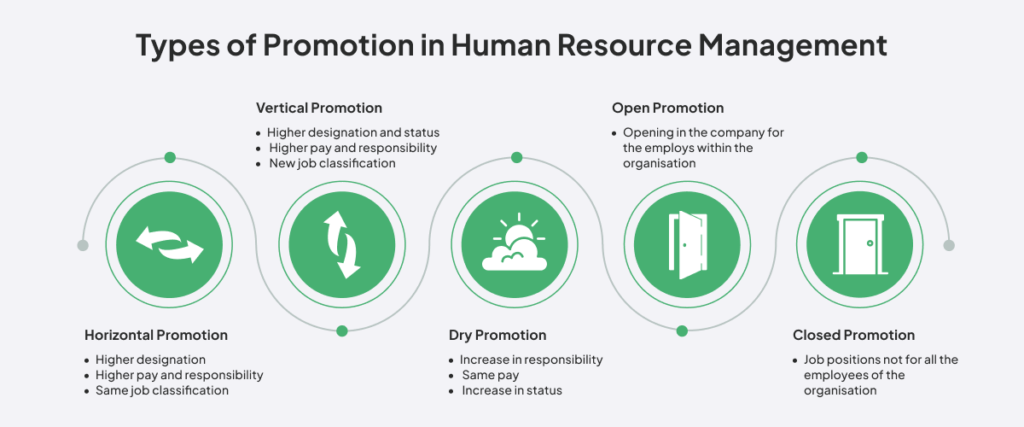
Horizontal Promotion
A horizontal, or lateral promotion, involves moving an employee to a different department or role at the same level. It may not include a significant raise in the salary, but it improves the employee’s skill sets.
Example: An ad copywriter moving to a social media strategist role at the same level within the company.
Vertical Promotion
This is the traditional move “up the ladder” where the employees move to a higher-ranking position with greater responsibility, authority, and compensation. They’re often tied to leadership development and succession planning.
Example: A marketing executive becoming an assistant marketing manager.
Dry Promotion
Where an employee receives additional responsibilities or a new title, but no increase in compensation. While dry promotions can sometimes be used during organizational restructuring or transitional phases, they can often lead to disengagement.
Example: A senior developer being given the title of team lead without a change in salary.
Open Promotion
A transparent process where the vacancy is announced to the entire organization, and any eligible employee can apply. This fosters a culture of fairness. This model is especially effective in larger organizations that prioritize structured internal mobility programs.
Example: A company posts an internal opening for a sales manager position, allowing all qualified sales representatives within the organization to apply.

Closed Promotion
When leadership selects a candidate directly without publicly announcing the opportunity internally. This approach is appropriate when the role demands specialized skills and a successor has already been identified.
Example: A senior financial analyst is directly promoted to finance manager after being mentored by leadership for the role.